
Quick answer: a useful spare parts recommendation for a shot blasting machine is not a parts catalog copy. It is a ranked action list built from three inputs: your wheel class and throughput, the measured wear life of each component in your abrasive and duty cycle, and a criticality tier that decides what must sit on your shelf, what can be ordered against a trigger, and what can wait for the supplier's lead time. In practice, a well-built recommendation for a single 360 mm universal-class wheel running 2,000 hours per year covers roughly 12 line items: 3 sets of Blades, 2 Impellers, 2 control cages, 2 distributors, 2 feed spouts, 1 set of top and Side Liners per 12 months, 1 set of chamber liners per 18 to 24 months, plus Bolts, end guards and a seal kit. Order everything in tier A against a reorder point, not against a calendar date, and your unplanned downtime from wheel wear parts typically drops below 2 hours per quarter.
Most buyers ask a supplier to "send me your parts list and prices" and then buy whatever wears out first. That approach produces three recurring failures: the fast-moving items are always on emergency order, the slow items tie up cash and warehouse space, and nobody notices that two wear parts fail together until the second one is already damaged. This article explains how a structured spare parts recommendation is built, what data it needs, how components are ranked by criticality, which parts belong to which wheel class, what materials and weights to expect, when to reorder, and how recommendations differ between a foundry, a steel fabricator and a shipyard. It ends with a 12-point checklist you can hand to any supplier and a FAQ for the questions buyers ask most.
A catalog lists what exists. A recommendation lists what you should own, in what quantity, and at what moment. The difference matters because wear in a shot blasting machine is not uniform. Two machines of the same wheel diameter can show blade life that differs by a factor of three if one runs chilled iron grit on rusty castings and the other runs rounded steel shot on descaled forgings. Recommendation logic therefore has to be built on measured data from your own line, not on a supplier's generic brochure table.
A properly built recommendation answers five questions in order:
Skipping any of these five steps is why so many maintenance stores carry 40 different part numbers for a machine that really needs 12.
Before anyone can recommend parts, six data fields must be fixed. Most of them are visible on the machine nameplate or in the electrical cabinet; the abrasive data comes from your media consumption records.
| Data field | Example value | Why the recommendation needs it |
|---|---|---|
| Wheel class and diameter | 360 mm universal class, 4 wheels | Determines blade length, impeller diameter and cage geometry |
| Turbine motor power | 11 kW per wheel | Sets the abrasive throwing rate the wear parts must handle |
| Rated abrasive flow | approx. 18-22 t/h per wheel at full gate | Wear life scales almost linearly with tons of media thrown |
| Media type and size | Steel shot S330 with 20% grit carryover | Grit content and angularity accelerate wear 30-80% versus round shot |
| Annual running hours | 2,000 h/year, two shifts | Converts component life in hours into calendar replacement dates |
| Workpiece mix | Castings 2-40 kg, batch 1,200 kg | Heavy or irregular parts increase liner and curtain wear |
With these six fields recorded, a competent supplier can already produce a first-pass recommendation without visiting the site. If a supplier quotes wear parts without asking for at least wheel class, media type and annual hours, treat the quote as a price list, not a recommendation.
Criticality ranking is the core of the recommendation. Each part gets a tier based on two questions: how fast the machine loses performance when the part wears, and how long the machine is down while the part is changed. The standard three-tier scheme looks like this:
| Tier | Definition | Typical parts | Stock policy |
|---|---|---|---|
| A - critical | Wear limits blasting quality within hours; change takes under 2 h but cannot wait for delivery | Blades, impeller, control cage, distributor | Minimum 1 full set on site per wheel, reorder point at 50% consumed |
| B - important | Gradual quality loss over days; change requires partial teardown (4-8 h) | Wheel housing liners, top and Side guards, feed spout, directional sleeve | 1 set on site per machine, reorder point at 25% remaining wall |
| C - planned | Slow wear, months of margin; change scheduled with other maintenance | Chamber liners, floor liners, rubber curtain strips, elevator buckets, seal kits | Order on demand against 8-15 day lead time, no standing stock |
Tier A is deliberately small. Only the four rotating wear parts inside the wheel housing belong there, because those are the parts that end a shift when they break. Everything that wears slowly enough to survive a two-week delivery belongs in tier C. The most expensive mistake in Spare Parts Management is promoting tier C items into shelf stock "to be safe" and then discovering that the cash is missing when a tier A blade set fails.
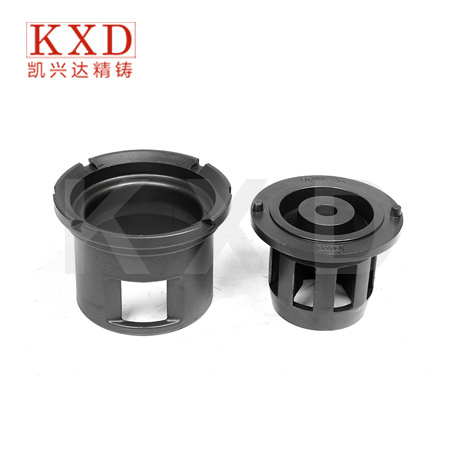
The control cage and distributor above are both tier A parts. They meter the abrasive stream into the wheel, and a worn cage window widens until the throwing pattern drifts off the workpiece. Because a cage is a casting with tight internal geometry, it should never be run "one more week" after the wear line is reached; the cost of one extra week is usually paid back in reblasting labor.
Recommendations must reference the correct wheel family. Although the wear principle is identical across wheel classes, the part dimensions, weights and bolt patterns differ. The four families most commonly serviced with replacement wear parts are:
| Wheel class | Wheel diameter | Typical motor power | Abrasive flow class | Common applications |
|---|---|---|---|---|
| 360 mm universal class | 360 mm | 7.5-15 kW | 12-25 t/h per wheel | General foundry cleaning, small castings, forgings |
| 500 mm heavy-duty class | 500 mm | 22-45 kW | 30-60 t/h per wheel | Structural steel, large castings, ship section descaling |
| 034 series square-corner | approx. 380 mm | 11-18.5 kW | 15-30 t/h per wheel | Retrofit into older swing-table and tumble machines |
| U105 series | approx. 490 mm | 15-30 kW | 25-45 t/h per wheel | Plate and profile shot blasting lines |
When requesting parts, state the wheel class and, if known, the original part number. Better still, send a photo of the worn part next to a ruler. Dimension checks that take the buyer one minute - blade length, blade fixing hole spacing, impeller bore diameter, cage mounting face - eliminate about 90% of first-delivery fit problems. A recommendation that cannot name the wheel class is a guess dressed up as advice.
Price differences between quotations usually trace back to material and heat treatment, not to machining. The benchmark specification for high-wear wheel internals is high-chrome cast iron, typically in the 24-28% chromium range with 2.2-3.0% carbon, quench-hardened to 60-64 HRC and tempered to relieve stress. Medium-wear liners are frequently supplied in the same alloy family, while chamber panels may use a tougher lower-chromium grade or a composite pad. The table below shows representative values for a 360 mm universal-class wheel:
| Part | Typical material | Hardness (HRC) | Approx. weight | Parts per set |
|---|---|---|---|---|
| Blade | High-chrome cast iron, 24-28% Cr | 62-64 | 0.9-1.3 kg | 8 |
| Impeller | High-chrome cast iron, heat treated | 60-63 | 6-9 kg | 1 |
| Control cage | High-chrome cast iron | 58-62 | 4-7 kg | 1 |
| Distributor (feed impeller) | High-chrome cast iron | 58-62 | 3-5 kg | 1 |
| Directional sleeve | High-chrome cast iron | 58-62 | 8-14 kg | 1 |
| Wheel housing liner | High-chrome cast iron or Ni-hard type | 55-60 | 10-18 kg each | 4-6 |
| Chamber liner panel | Chromium-molybdenum steel or Cr15-Cr20 plate | 48-56 | 15-45 kg each | 8-20 |
Two specification details deserve attention in every recommendation. First, request the actual hardness report, not just the phrase "high chrome": a casting supplied at 52 HRC will lose roughly 30-40% of its life against a properly hardened 62 HRC part, which erases any unit-price saving. Second, confirm weight. Weight is the cheapest authenticity check available to a buyer - a blade claimed as high-chrome but weighing 15% less than your worn original is almost always a leaner, softer alloy.
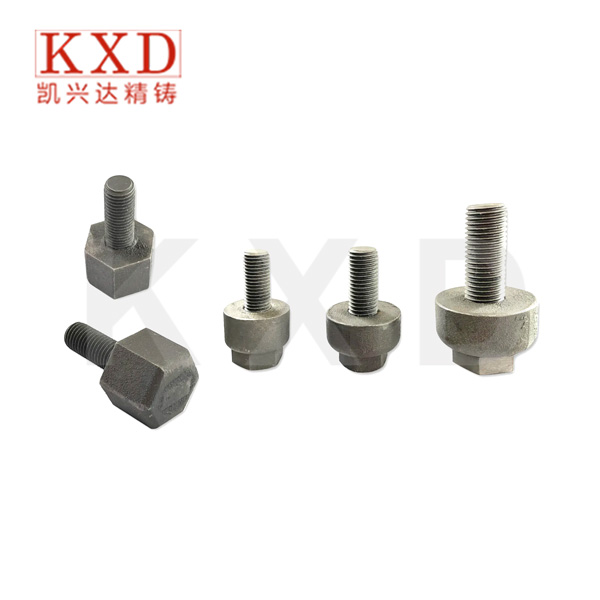
Fasteners are small but belong in every recommendation. Wheel internals are fixed with high-strength bolts and Cap Nuts that work loose under vibration and must be replaced at every second blade change; a loose blade destroys the impeller within minutes. Budget one full fastener set per wheel per overhaul.
A recommendation becomes operational when each line item carries a replacement interval and a reorder point. The intervals below assume a 360 mm universal-class wheel, chilled-iron-free steel shot with moderate grit, 2,000 hours per year. Angled media, higher gate openings or continuous heavy castings shorten these numbers by 20-50%.
| Part | Typical life (hours) | Calendar equivalent at 2,000 h/y | Recommended reorder point |
|---|---|---|---|
| Blades | 300-600 h | every 2-3 months | when 50% of shelf stock is consumed |
| Impeller | 600-1,000 h | 2× blade interval | at second blade change |
| Control cage | 500-900 h | every 3-5 months | at first blade change after midpoint wear |
| Distributor | 600-1,000 h | similar to impeller | with impeller |
| Wheel housing liners | 800-1,500 h | every 6-9 months | when wall thickness reaches 40% of original |
| Directional sleeve | 1,000-2,000 h | every 6-12 months | when blast pattern drift is first corrected |
| Chamber liners | 2,000-4,000 h | every 12-24 months | at annual survey, 3 weeks before planned change |
| Fastener set | every second blade change | 4-6 months | with each blade order |
Two rules keep these numbers honest. First, measure, do not estimate: at each change, weigh the removed blade or measure the liner wall and log it. After three cycles you will have a wear curve specific to your machine instead of a brochure range. Second, replace paired components together. The impeller and distributor share a window; the cage should follow the blades; leaving the older part in place to "finish its life" usually costs a second teardown two weeks later.
The same wheel class serves very different duties across industries, and the recommendation weighting shifts accordingly.
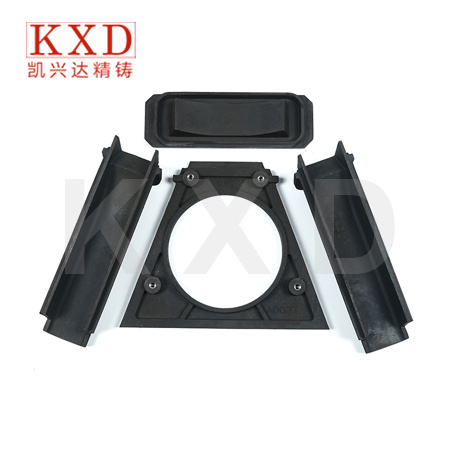
Around the wheel, several parts share a replacement window, and buying them as kits reduces both price and downtime. A sensible Tune-up Kit for a 360 mm universal-class wheel contains: 8 blades, 1 impeller, 1 control cage, 1 distributor, 1 fastener set with cap nuts, and the housing liner set if the inspection shows the wear line approaching. Purchased as a kit, the set price typically lands 8-15% below the sum of single items, and - more importantly - the machine is opened once instead of three times.
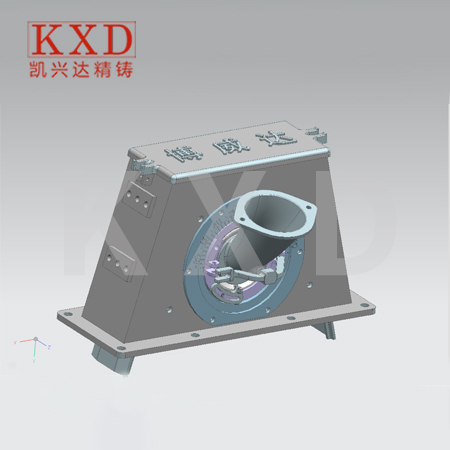
The housing assembly view above shows why kits make sense: the liners, cage and distributor all sit inside the same envelope, and each teardown risks disturbing the sealing surfaces of the others. A workshop that rebuilds the full wheel from one kit in a planned 4-hour window will always beat a workshop that chases individual failures across the quarter.
A supplier who answers all twelve points without prompting is worth a slightly higher unit price. A supplier who avoids the material certificate or the hardness report is selling you a guess.
For one 360 mm universal-class wheel running about 2,000 hours a year, the working core is around 12 line items: one blade set plus one spare set, one spare impeller, one spare control cage, one spare distributor, one spare directional sleeve, one spare housing liner set, fastener sets, and chamber liner panels ordered against the annual survey. Anything beyond that should earn its place through a measured consumption record.
Check three things: a hardness test report showing 60-64 HRC for wheel internals, a weight within 5% of your worn original, and clean machining on the mounting faces. If the supplier will not provide the hardness report, assume the part is softer than quoted.
Always as a full set of eight. Mixed old and new blades create an unbalanced wheel, accelerate wear on the newer blades, and can produce vibration that damages the impeller and bearings.
Watch the blast pattern and the ampere load. A worn cage window widens, the pattern drifts from the workpiece center, cleaning time lengthens, and the wheel motor draws more current for the same result. Physically, the cage window edge shows a rounded wear step you can catch with a fingernail.
Usually yes for the wheel internals. The kit price is lower, the machine is opened once, and the spare items from the kit become your shelf stock for tier A. Only exclude parts whose measured wear is clearly below half life.
Wear life is driven by media angularity, grit carryover, gate opening, workpiece mass and separator condition. Two machines can differ by a factor of three. This is why a recommendation must be built from your own wear log, not from generic tables.
They can produce a first draft, but you should still verify fit with the worn originals. Nameplates and part numbers get lost on rebuilt machines, and a wheel class confirmation by dimensions takes minutes and prevents the most expensive category of error: a full set of parts that does not bolt on.
For a single 360 mm universal-class wheel at 2,000 hours per year, a realistic annual wear parts budget falls between 35% and 60% of the cost of one complete wheel assembly, dominated by 6-10 blade sets, 2-3 impellers and 2-3 cages. Machines running angular media or heavy castings trend to the top of the range.
Control the working mix. Keeping the media classified - correct size distribution, low broken-shot share, minimal sand or scale carryover - extends every downstream wear part by 20-40% at zero parts cost. The separator, not the wheel, is where most money is saved.
A professional spare parts recommendation for a shot blasting machine is a ranked, data-backed list - not a catalog. Fix the machine audit data first, rank parts into three criticality tiers, keep tier A (blades, impeller, control cage, distributor) on the shelf with reorder points, hold one set of tier B liners, and order tier C against planned maintenance windows. Match every part to the correct wheel class and verify material through hardness reports and weights rather than price. Replace paired components together, buy wheel internals as kits, keep a wear log, and fix the abrasive classification system before blaming the castings. Buyers who follow this structure typically cut unplanned wheel downtime to a few hours per quarter and reduce total wear parts spend by 10-20% in the first year - without changing a single supplier.



CERTIFIED UNI EN
ISO 9001:2015
16-Q-0200122-TIC



In the past 20 years, we adhere to the concept of people oriented and commitment to integrity, strictly abide by the rules of safety in production, environment protection and occupational disease prevention, delicate to

 Español
 Pусский
 Deutsch
 Italiano


Comment
(0)